
WSD vs. cosine decay learning rate for Phase 2: continual pretraining
Continual pretraining means starting the next phase of training from a cooled checkpoint. A cosine decay learning-rate schedule is best suited for fixed-budget training. Phase 2 has a mix of code, agentic, and English data. What’s the best move for Phase 2? Should we continue with cosine decay or use WSD?
Why we kept warmup–stable–decay for Phase 2
We decided to introduce annealing for Phase 2. The idea was to rewarm a cooled English checkpoint to 40% of the original peak, carry forward the optimizer state, and train for 12B more tokens, with the final 2B reserved for a linear cooldown.
Marin’s 8B run provides a close precedent for that decision. They faced a similar decision with a cooled model, more compute, and a changed corpus. Their restart returned all the way to the previous peak. Ours returns to 40%.
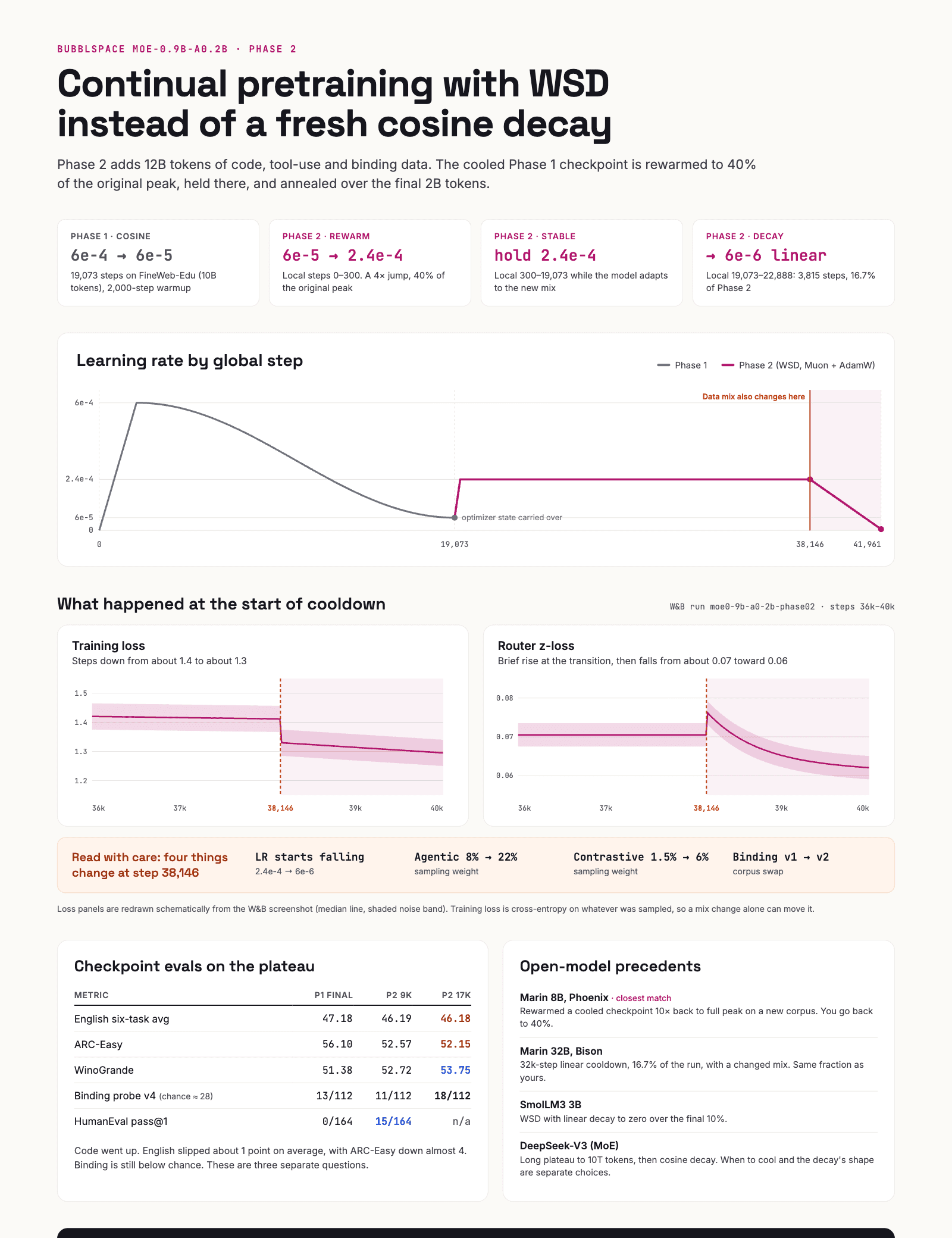

The learning-rate schedule we ran
| Stage | Optimizer steps | Learning rate |
|---|---|---|
| Phase 1 · English pretraining | 19,073 total | 2,000-step warmup to 6e-4, then cosine decay to 6e-5 |
| Phase 2 · Rewarm | Local 0–300 | 6e-5 to 2.4e-4, four times the Phase 1 endpoint |
| Phase 2 · Stable | Local 300–19,073 | Holds 2.4e-4, 40% of the Phase 1 peak |
| Phase 2 · Decay | Local 19,073–22,888 | Linear decay from 2.4e-4 to 6e-6 over 3,815 steps (16.7% of Phase 2) |
The config still has a top-level decay: cosine entry. In the trainer, the phase2 block selects a dedicated WSD scheduler for both Muon and AdamW. Initialization with --init_from carries forward the model weights, Muon momentum buffers, and AdamW moments while starting a fresh schedule at local step zero. W&B adds 19,073 to Phase 2’s local step. The cooldown boundary is therefore global step 38,146, and the planned endpoint is 41,961.
What other open training runs tell us
Marin 8B is the closest precedent. After Kestrel’s cyclic WSD and Ocelot’s sustained high learning rate, Jellyfish cooled from 1.7e-3 to 1.7e-4. With more training available, Phoenix rewarmed tenfold over 2,000 steps as it switched toward Nemotron-CC and code, then held the previous peak. Starling cooled again. We faced the same kind of restart and chose a smaller rewarm, to 40% of our original peak.
| Run | Published schedule | How it informs Phase 2 |
|---|---|---|
| Marin 32B · Bison | 32,000-step linear cooldown from step 160k to 192k with a new mixture | The cooldown occupied 16.7% of the run, the same fraction we chose. The right duration for this MoE is still an empirical question. |
| Marin Mochi · 535B-A23B | The initial 18T-token spec used 1% warmup and linear decay toward 5% of peak | A fixed-budget alternative. Marin’s restart of the cooled 8B checkpoint is the closer comparison with our run. |
| Hugging Face SmolLM3 · 3B | WSD at 2e-4, 2,000 warmup steps, and linear decay to zero over the final 10% | A smaller open model used the same plateau and linear cooldown. Its AdamW setup and 2.36M-token batch limit comparisons of the peak rate. |
| DeepSeek-V3 | Held 2.2e-4 until 10T tokens, cooled with cosine over 4.3T, then used two lower fixed rates over the final 500B | A long plateau also has an MoE precedent. The timing of the cooldown and its curve shape are independent choices. |
Ibrahim et al. studied continued pretraining at 405M and 10B parameters, including a switch from The Pile to SlimPajama. Their experiments combined learning-rate rewarming, cosine re-decay, and replay of prior data, including a 5% replay condition. That supports rewarming and retaining some FineWeb-Edu independently of our choice of a linear cooldown. FineWeb-Edu remains in our cooldown mix at an estimated 5.7% of Stage 2B tokens. Hägele et al. separately found that a constant learning rate followed by a cooldown scaled comparably to cosine in their experiments.
- Marin 8B retrospective
- Marin 32B retrospective
- Mochi run specification
- SmolLM3 training recipe
- DeepSeek-V3 technical report
- Ibrahim et al. on continual pretraining
- Hägele et al. on cooldowns
What the plateau checkpoints showed
| Metric | Phase 1 final | Phase 2 · local 9k | Phase 2 · local 17k |
|---|---|---|---|
| English six-task average | 47.18 | 46.19 | 46.18 |
| ARC-Easy (normalized accuracy) | 56.10% | 52.57% | 52.15% |
| WinoGrande (accuracy) | 51.38% | 52.72% | 53.75% |
| Held-out binding probe v4 | 13/112 | 11/112 | 18/112 |
| HumanEval pass@1 | 0/164 | 15/164 | — |
HumanEval moved from zero to 15 passing programs at 9k. The English average was one point below Phase 1 at 17k, with ARC-Easy down nearly four points even as WinoGrande rose. The held-out binding probe reached 18/112, below its approximate chance reference of 28/112. These checkpoints support three separate judgments about code generation, English retention, and binding. The dash indicates that this comparison has no HumanEval result for 17k.
How we’ll judge the cooldown
The training loss dropped around the global 38k boundary. The learning rate started falling at the same time the sampler increased tool-use data from 8% to 22%, increased contrastive data from 1.5% to 6%, and switched the binding corpus from v1 to v2. The plotted loss is cross-entropy on the sampled training batch, so changes in which examples the model sees can move the curve immediately. Held-out results by domain are needed to tell where the model improved.
We’ll compare local step 19,000, taken 73 steps before the transition, with the planned final checkpoint at 22,888. We’ll use the same six English tasks, HumanEval or CRUXEval under matching settings, and binding probe v4. This measures the Stage 2B recipe as a whole. Establishing a schedule advantage over cosine would take a separate run from the same Phase 1 checkpoint, matched on token budget, data schedule, and evaluation. The published evidence and plateau results gave us enough reason to finish this run as configured.